The appeal of risk-averse storytelling is undeniable. “Cozy” refers to more than a subgenre of mystery writing: it can reflect a more general attitude, a reading posture that prizes the familiar, the safe, the fashionable. In effect, cheering for a team. A team can take many shapes: for instance, as fans of a particular genre, or as tenured specialists with a career to grind. Or as hipper-than-thou media opinionators who lay down the law for the rest of us. These line-ups are diverse, but they all share, despite their differences, a common suspicion of stories that upset expectations.
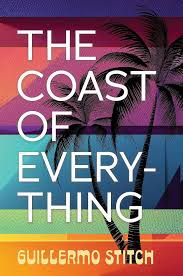
We could all do with a bit of soothing, I suppose, but we can also imagine other ways to play the game. Truly memorable books aspire to be more than non-allergenic toys. “Safety first” is not a precept for ambitious literature. Guillermo Stitch’s The Coast of Everything (Sagging Meniscus, 750 pages) can be described as a novel that is eager to push past guardrails. This is not the work of a team player, unless one imagines an altogether different kind of contest allowing an individual to play simultaneously on different, or even opposing, sides.
With a startling array of characters, settings and styles, the novel pays homage to Scheherazade of One Thousand and One Nights. It spins out tales of Germanic mountain villagers, of the North African underworld, and predatory media moguls of the future. There is Chandleresque noir and Pynchonian paranoia and in one section, a cameo appearance by Charles Dickens, who contributes a dystopian sci-fi tale about a mysterious island, recounted in high Victorian style. Five central stories bleed into each other, with various subplots. And these pages also contain recipes.
For a reviewer, it’s hard to summarize, much less to label these goings-on, but one of the considerable merits of The Coast of Everything is that it leaves you pondering not only the book in question but the workings of literature in general. Formally speaking, it relies on a strategy of nested stories like Russian dolls, but having said as much, the novel’s chief interest doesn’t reside in its narrative athleticism. It engages on many other levels.
For instance, The Coast embodies a riposte against some of the didactic excesses of identity politics. In recent decades, many writers have asserted—rightly so—personal and community prerogatives to tell stories that were previously excluded from the canon. But at the same time, some writers—more debatably—have questioned the access of other authors to their imagined worlds. In her excellent essay, “Fascinated to Presume: In Defense of Fiction,” Zadie Smith pinpoints a problem: “The old—and never especially helpful—adage write what you know has morphed into something more like a threat: Stay in your lane.”
Good advice for traffic safety, but for fiction? The risk here is of atomization, of didacticism and reducing the scope of literature. Smith continues:
“Do we know what fiction was? We think we know. In the process of turning from it, we’ve accused it of appropriation, colonization, delusion, vanity, naiveté, political and moral irresponsibility. We have found fiction wanting in myriad ways but rarely paused to wonder, or recall, what we once wanted from it—what theories of self-and-other it offered us, or why, for so long, those theories felt meaningful to so many. Embarrassed by the novel—and its mortifying habit of putting words into the mouths of others—many have moved swiftly on to what they perceive to be safer ground …”
In The Coast of Everything, Stitch is not embarrassed by the novel. He is constantly putting words into the mouths of others. He ventriloquizes different races, sexes and ethnicities, as well as class differences and historical registers of English. A major plot thread concerns Liam Téad, an Irish investigator who works in California but finds himself transported to Cairo, considering the life of a rich and perplexing woman:
“It was probably impossible to narrate a story like that, a story set in a world like that—a world populated by people who, if he was honest with himself, he resented from the off for their money, their power and their privilege—without rubbing Liam up the wrong way. Coming from the nose-against-the-window classes, he had carefully curated a set of values and attitudes that made the cold street seem somehow right and the cosy salon somehow wrong. Trustworthy people lived on his side of the glass. Why then, whenever there was a window to press his nose against, did he so dutifully press his nose against it? His progress through the world could be traced in a series of greasy nose prints. While his current associations were more salon than street, that was both precarious and illusory.”
You could say Liam’s character incarnates the tensions of the stay-in-your-lane attitude. Meanwhile, Stitch, the author, is off to the races. The narration that Liam judged “probably impossible” is elsewhere served up on the page in the woman’s voice. The novel is a polyphonic performance, reaching beyond the particular interest of individual characters or groups, to explore the nature of narrative itself.
Elsewhere, a long section of The Coast of Everything depicts a future in which utilitarian functionality is the pre-eminent value, and narrative is of interest only for its non-literary applications. In this imagined post-codex era, referred to as the “Second Enlightenment,” literature is worse than obsolete. It is considered dangerous, and texts from the “First Era” are ruthlessly purged. In a further embedded story, the uses of narrative as the driving force of consumerism is dramatized by the tales of the Zade family and their famous twin daughters:
“The Zade twins were a meme. Considered the embodiment of Zade duplicity. Their father’s media group was as essential to life in this country, and all the other countries, as it was despised and distrusted. What you thought of the Zade machine, though, was of no consequence. It owned the main news outlets and it owned the outlets the main news outlets called fake news outlets, which in turn and of course accused the main news outlets of being fake news, so nobody could be confident anymore about which was which, or why it mattered. And by one circuitous route or another, Zade owned it all. Zade was hardwired into your device. Into your car. If you could afford the right type of refrigerator, it was there too. And it owned social media. […] It probably didn’t own you, yet, but then you had been pretty much atomized. You weren’t worth owning. And it didn’t need to own you to sell you anyway. And somehow the twins embodied all of this.”
Working on such an enormous canvas will inevitably run counter to the expectations of readers who, in our digital era of reduced attention spans, assume that the novel should follow suit. To do otherwise can seem an act of hubris, maybe even a guy thing. (In which case, Donna Tartt and Lucy Ellmann, among others, didn’t get the memo.) In any case, The Coast of Everything rejects such circumscribed views. Though long and complicated, it remains accessible and reader-friendly, perhaps precisely because it feels unpoliced.
Since the author is Irish, and the book is uncommonly ambitious, the shadow of James Joyce looms large, but there are signal differences here. Ireland is mentioned only briefly in The Coast of Everything, whose stories favor other settings and continents. The Roman Catholic Church doesn’t really figure; and though the text is wide-ranging in its literary allusion, there is not the conspicuous performative erudition of Joyce. (George Orwell, even as he praised Ulysses, referred to its author as an “elephantine pedant.”) The author of The Coast of Everything avoids such displays. His style is not Joycean but rather throbs with its own imperative pulse, earning the right to be called Stitchian. This is a remarkable novel by a writer who does not play safe.
______________________________________________
Charles Holdefer’s next novel, Move the Mountain, will be published in April 2027.